
The Difference Between Prime, Standby, and Continuous Power in Electric Generators
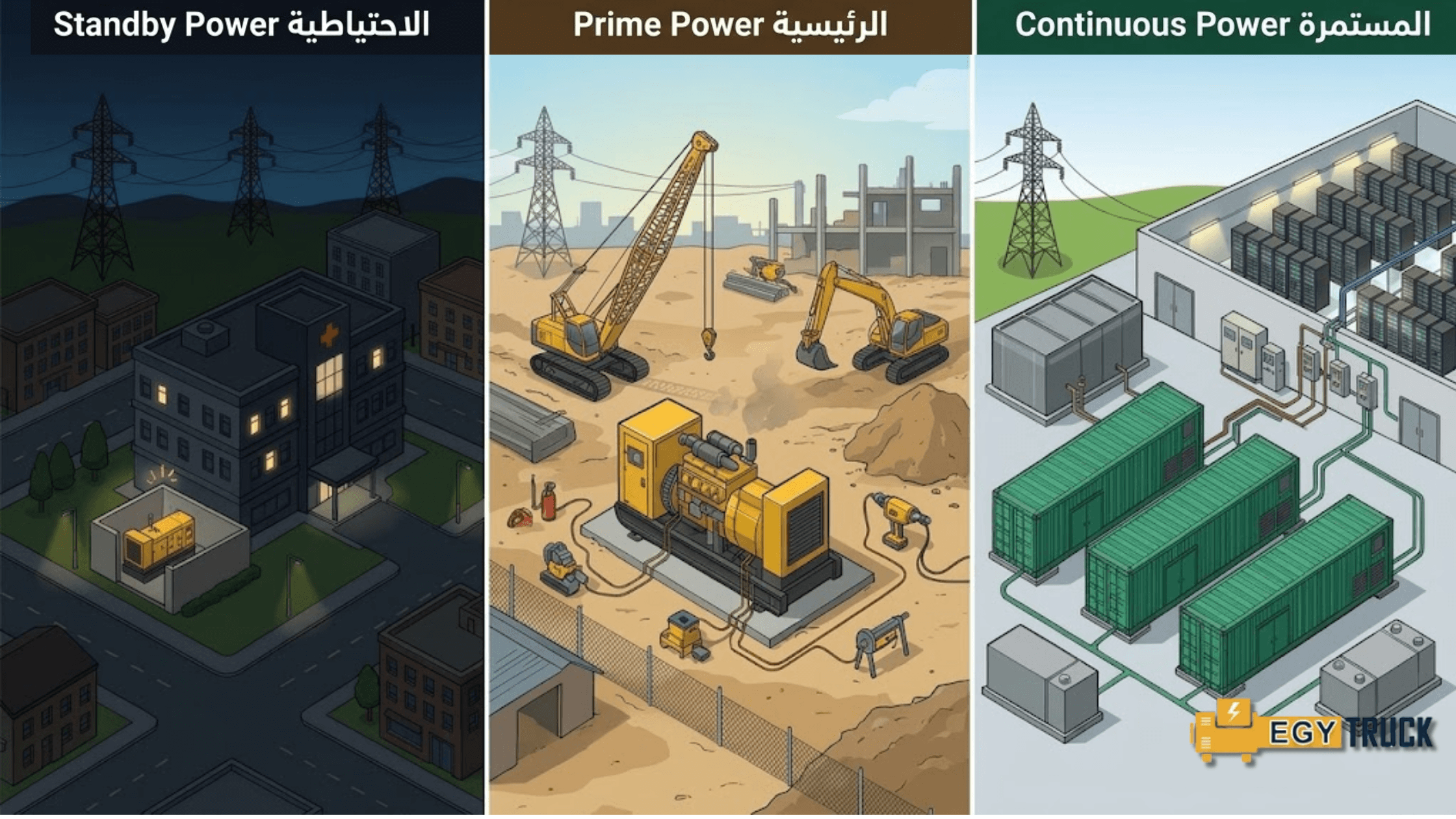
When searching for a diesel generator for sale or rent, you will find that manufacturers classify generator capacities according to their operating conditions and intended applications. The most common classifications include Prime Power, Standby Power, and Continuous Power.
The differences between these classifications go beyond the generator’s electrical capacity. They also involve permitted operating hours, the nature of electrical loads, average load levels, and the conditions under which the generator is used.
Understanding these classifications is essential before purchasing or renting an electric generator. Choosing a rating that does not match your project’s requirements may force the generator to operate beyond its design limits, increase engine stress and maintenance costs, and reduce the equipment’s service life.
In this article, we explain the differences between Prime, Standby, and Continuous Power, the applications of each rating, and how to choose the appropriate capacity for your project.
What Are Generator Power Ratings?
Generator power ratings are technical classifications that define the operating conditions a generator is designed to handle, including the nature of the electrical load, operating hours, and the power output the generator can provide.
The most important generator ratings include:
- Prime Power (PRP): The rating for primary operation under variable loads.
- Emergency Standby Power (ESP): The rating for backup operation when the primary power source fails.
- Continuous Operating Power (COP): The rating for continuous operation under constant loads.
It is important to note that the rated capacity of the same generator may vary depending on its intended application. Therefore, you may find more than one power rating in the technical datasheet for a single generator model.
What Is Prime Power (PRP)?
Prime Power is a generator rating designed for units that operate as the primary source of electrical power, particularly at sites where a reliable public electricity supply is unavailable or where generators are required to operate for extended periods.
This rating allows the generator to operate for an unlimited number of hours per year, subject to the operating and maintenance conditions specified by the manufacturer, while accommodating variations in electrical loads during operation.
Key Characteristics of Prime Power Generators
- Designed for extended operating periods with unlimited annual operating hours, subject to the rating conditions.
- Suitable for variable electrical loads.
- Can serve as the main power source instead of the public electricity grid.
- Allows load levels to vary during operation.
- Requires compliance with the manufacturer’s maintenance schedule and operating instructions.
- Subject to specific average load and maximum output limits according to its rating.
Applications of Prime Power Generators
These generators are used in projects that rely on generators as their primary power source, such as:
- Construction sites without access to a stable electricity grid.
- Factories and remote industrial facilities.
- Oil and gas projects.
- Water pumping stations and agricultural projects.
- Mining and quarrying sites.
- Projects that require equipment to operate for extended periods.
When Do You Need a Prime Power Generator?
This rating is suitable when the generator serves as the primary source of electricity rather than simply providing backup power during an outage.
For example, if you have a construction site in an area without access to the public electricity grid, and the site requires machinery, pumps, and equipment to operate for several hours every day, it is preferable to choose a generator rated for Prime Power operation based on the project’s actual load requirements.
What Is Standby Power (ESP)?
Standby Power is a generator rating for units used as a backup power source when the primary electricity supply, such as the public power grid, is interrupted.
The generator remains on standby most of the time and is activated when needed to supply power to the required loads during an outage.
Key Characteristics of Standby Power Generators
- Designed to provide power when the primary electricity supply fails.
- Used intermittently and not designed to serve as the permanent primary power source.
- Can deliver its rated output during an outage, subject to the manufacturer’s specified conditions.
- The load limits defined by the ESP rating must not be exceeded.
- Requires periodic operational testing to ensure readiness.
- Annual operating-hour limits and maintenance requirements must be observed.
Applications of Standby Power Generators
These generators are used in facilities that cannot afford power interruptions, including:
- Hospitals and medical centers.
- Banks and financial institutions.
- Hotels and resorts.
- Data centers and server facilities.
- Factories that require a backup power source.
- Shopping centers and critical facilities.
When Do You Need a Standby Power Generator?
This rating is suitable when your facility primarily relies on the public electricity grid but requires a backup generator to handle power outages.
For example, hospitals need standby generators to supply electricity to systems and equipment that must continue operating when the primary power source fails.
It is important to identify the critical loads that the generator must supply rather than automatically assuming that a standby generator needs to power every load in the facility.
What Is Continuous Power (COP)?
Continuous Operating Power is a generator rating designed to provide a constant and stable electrical output for an unlimited number of hours per year while operating under a constant electrical load, subject to the manufacturer’s specified conditions.
This rating differs from Prime Power in terms of load characteristics. Prime Power allows the generator to handle variable loads, whereas Continuous Power is intended to provide a continuous power supply to a constant or nearly constant load.
Key Characteristics of Continuous Power Generators
- Designed for continuous operation throughout the year.
- Provides a constant electrical output according to its specified rating.
- Suitable for applications that require stable loads.
- Can serve as the primary power source at suitable sites.
- Requires compliance with the manufacturer’s maintenance schedule and operating conditions.
- Additional capacity for sudden load increases beyond the specified rating should not be assumed.
Applications of Continuous Power Generators
These generators are used in applications that require a continuous and stable power supply, such as:
- Industrial facilities operating under constant loads.
- Power generation stations.
- Certain water pumping stations.
- Projects that rely on an independent electricity source.
- Applications operating under a base-load system.
- Certain systems operating in parallel with the electricity grid.
When Do You Need a Continuous Power Generator?
If your project relies on a generator to provide a continuous power supply at an approximately constant load, this rating may be the most suitable option.
For example, some industrial facilities may require a generator that delivers stable power throughout their operating hours without relying on the public electricity grid.
What Is the Difference Between Prime, Standby, and Continuous Power?
The following table summarizes the main differences between the three generator ratings:
| Comparison Factor | Prime Power (PRP) | Standby Power (ESP) | Continuous Power (COP) |
| Primary Application | Main power source | Backup power source | Continuous power source |
| Load Characteristics | Variable | Variable | Constant |
| Annual Operating Hours | Unlimited, subject to rating conditions | Up to 200 hours per year under the ESP rating | Unlimited |
| Primary Electricity Source | The generator itself | Public electricity grid | The generator itself or a suitable operating system |
| Average Load | Subject to rating limits | Subject to rating limits | Based on the permitted constant load |
| Overload Capability | Subject to manufacturer specifications and rating conditions | Should not be assumed to be permitted | Should not be assumed to be permitted |
| Common Applications | Construction sites and remote factories | Hospitals, hotels, and factories as backup | Continuous industrial operation |
Note: This table illustrates the general differences under ISO ratings and does not replace the specifications of a specific generator. Some manufacturers also use Standby ratings with operating conditions and annual operating-hour limits that differ from ESP.
A Practical Example of the Differences Between Generator Ratings
Suppose three different projects require electric generators with similar capacities, but each project has different operating requirements.
| Project | Operating Requirements | Initially Suitable Rating |
| A factory that relies on the generator as its primary electricity source under variable loads | Long daily operating periods | Prime Power |
| A hospital that relies on the electricity grid and needs a backup source during outages | Emergency operation when required | Standby Power |
| An industrial facility operating under a constant load and relying continuously on a generator | Continuous operation under a constant load | Continuous Power |
This example demonstrates that generator selection is not based on electrical capacity alone. The rating must also match the operating conditions, working hours, and load profile.
7. Does Generator Capacity Differ Between Prime, Standby, and Continuous Ratings?
Yes. The rated capacity of the same generator may differ depending on its operating rating.
When reviewing a generator catalogue, you may find several power ratings, such as:
- Standby kVA
- Prime kVA
- Continuous kVA
This is because each rating represents different operating conditions. A generator is not necessarily capable of delivering its highest advertised output continuously under all operating conditions.
For example, a manufacturer may specify a higher Standby capacity than Prime capacity for the same model because standby applications involve different operating conditions from extended primary operation.
Therefore, when comparing two generators, do not compare their rated capacities alone. Make sure you compare their capacities under the same operating rating, while also reviewing fuel consumption, actual power output, and load conditions.
8. How to Choose the Right Generator Rating Before Renting
Before deciding to rent an electric generator, you should clearly identify your operating requirements.
Here are the most important factors to consider:
1. Identify the Primary Power Source
Does your project rely on the public electricity grid and require a generator for emergencies? Or will the generator serve as the primary power source?
- For backup applications, consider a Standby rating.
- For primary operation under variable loads, consider a Prime rating.
- For continuous operation under constant loads, consider a Continuous rating.
2. Determine the Daily Operating Hours
You should estimate the expected operating hours per day, month, and year. This helps eliminate ratings that are unsuitable for your project’s operating requirements.
3. Assess the Electrical Loads
Calculate the total loads the generator will need to supply, taking into consideration:
- Loads operating simultaneously.
- Motor starting currents.
- Variable loads.
- Power factor.
- Future expansion requirements.
4. Review Fuel Consumption
Fuel consumption varies according to generator capacity, load percentage, and model. Therefore, you should review the manufacturer’s data to estimate fuel consumption under actual operating conditions.
5. Check Maintenance Requirements
Each rating requires compliance with the generator’s maintenance schedule and permitted operating conditions. As operating hours increase, preventive maintenance and engine condition monitoring become increasingly important.
Why Choose Egy Truck for Your Generator Requirements?
Egy Truck provides comprehensive solutions for the sale, rental, and maintenance of diesel electric generators across different capacity ranges, catering to the needs of factories, construction projects, commercial sectors, and critical facilities.
We work with international brands such as:
- Caterpillar
- Volvo
- Komatsu
- Airman
- Denyo
We also provide generator installation, commissioning, and testing services, along with maintenance and technical support throughout the rental period.
Our services cover Cairo, Alexandria, Port Said, Ismailia, Suez, and Ain Sokhna.
Whether you are looking for a Prime Power generator to operate a factory, a Standby generator to provide backup power, or a Continuous Power generator for uninterrupted operation, the Egy Truck team can help you identify suitable options based on your project’s requirements and the generator’s technical specifications.
Conclusion: Which Generator Rating Is Best?
There is no single rating that is best for every application. The right choice depends on your operating conditions and project requirements:
- Prime Power: Best suited when the generator is the primary power source and operates under variable loads for extended periods.
- Standby Power: Best suited for providing backup power when the primary electricity supply fails.
- Continuous Power: Best suited for continuous operation under a constant or nearly constant load.
Understanding the differences between these ratings helps you choose a generator that delivers the required performance, maintains operational efficiency, and reduces the risk of breakdowns and unnecessary costs.
Need Help Choosing the Right Generator Rating?
Whether you are looking for an electric generator for sale or rent, contact the Egy Truck team to determine the appropriate capacity and rating based on your project’s requirements, operating hours, and electrical loads.
Get technical advice and a quotation tailored to your needs, with comprehensive solutions covering generator supply, installation, commissioning, and maintenance.
Similar Articles
Advantages And Disadvantages Of Diesel Generators
Advantages And Disadvantages Of Diesel GeneratorsDiesel generators are among the most important energy solutions today, especially in industrial and commercial sectors that rely on continuous operation. However, choosing a diesel generator shouldn't be a random...
A Guide To Choosing The Right Generator For You
A Guide To Choosing The Right Generator For YouIn a world where energy demands are accelerating and project needs are increasing, choosing the right generator is a critical decision that can make a significant difference to your business continuity and profitability....
Common Mistakes When Choosing A Power Generator For Factories
Common Mistakes When Choosing A Power Generator For FactoriesChoosing a power generator for factories is a decision that has a major impact on production, costs, and safety. Unfortunately, many factories make common mistakes that lead to frequent breakdowns,...