
How to Choose the Right Generator Before Renting: A Complete Guide
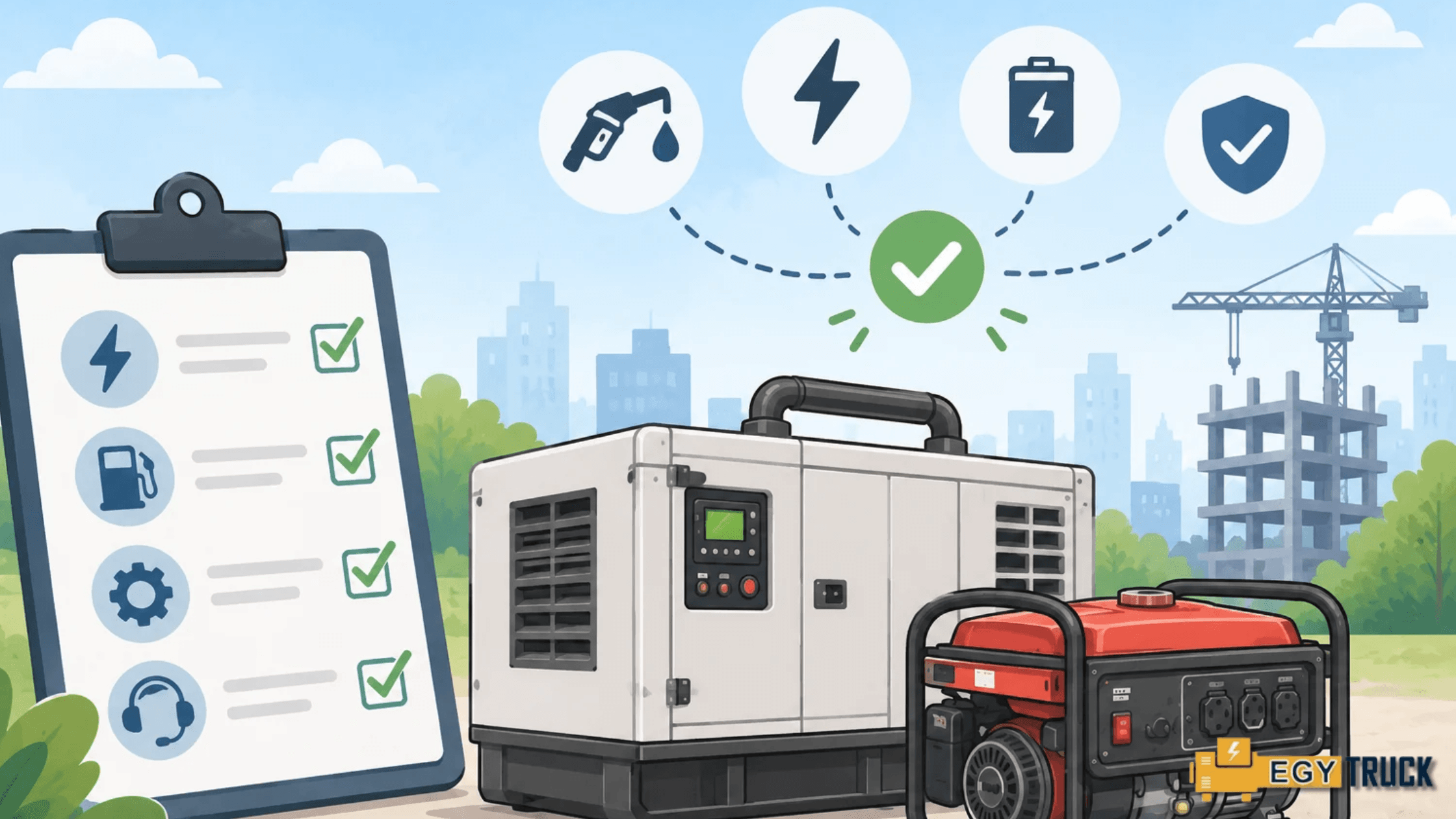
Choosing the right generator before renting is essential to ensuring business continuity and avoiding unnecessary operating costs. Whether you need a generator to power a factory, provide electricity at a construction site, or secure a backup power source for a hospital or commercial facility, selecting a generator involves more than simply considering its electrical capacity. It requires evaluating several technical and operational factors.
Choosing a generator with insufficient capacity may lead to overloading and equipment shutdowns. On the other hand, renting a generator with a capacity far greater than your actual requirements may increase operating costs and fuel consumption without providing any real benefit.
In this guide, we cover the most important factors to consider when choosing a generator for rent, how to determine the appropriate capacity, and which specifications you should review before signing a rental agreement.
1. Determine the Purpose of the Generator
Before searching for generators for rent, you should identify how and why the generator will be used. This affects the generator type, required capacity, and operating specifications.
Generator applications can generally be divided into the following categories:
Standby Generators
These generators serve as an alternative power source when electricity from the public grid is interrupted. Facilities that rely on backup power systems need a generator capable of starting and supplying the required loads according to the response time and electrical transfer system in use.
They are commonly used in:
- Hospitals and medical facilities.
- Factories and production lines.
- Hotels and shopping centers.
- Data centers and telecommunications systems.
- Facilities that require essential systems to remain operational.
Prime Power Generators
These generators are used when the generator serves as the main source of electricity, whether because a public power grid is unavailable, unstable, or unsuitable for the project’s requirements.
They are suitable for:
- Construction and contracting sites.
- Industrial projects.
- Remote areas.
- Oil and gas sites.
- Projects that require equipment to operate for extended periods.
Tip: Make sure you identify the required operating type before renting. Prime and Standby ratings differ in terms of operating conditions and permitted power output. Always refer to the manufacturer’s rating for the specific model.
To learn more about generator types and their applications, read our guide on Types of Diesel Generators and Their Different Applications.
2. Calculate the Required Electrical Capacity Before Renting a Generator
Electrical capacity is one of the most important factors when selecting a suitable generator. Therefore, you should determine the total load the generator will need to support before choosing its capacity.
Start by preparing a list of all the equipment and appliances that will operate using the generator, and record the electrical power required by each one.
Potential loads include:
- Motors and industrial equipment.
- Water pumps.
- Air conditioning and cooling systems.
- Production lines and machinery.
- Lighting and electrical systems.
- Computers and servers.
After listing the loads, identify which devices will operate simultaneously, as the combined rated power of all equipment does not always represent the actual load required.
For a more detailed explanation of load calculations and how to determine generator capacity, see our Guide to Choosing the Right Electric Generator.
The Difference Between kW and kVA When Choosing a Generator
It is important to understand the difference between kilowatts (kW) and kilovolt-amperes (kVA), as generators are often rated in kVA, while actual power is measured in kilowatts.
Actual power can be calculated using the following formula:
kW = kVA × Power Factor
For example, a 100 kVA generator with a power factor of 0.8 provides a rated actual power output of 80 kW.
Make sure to verify the actual power factor on the generator’s nameplate and consider the nature of the connected loads before determining the required capacity.
Do Not Overlook Starting Current
Some equipment, particularly motors, pumps, and compressors, requires a higher current during startup than during normal operation.
Therefore, you should consider:
- The starting current of the equipment.
- The number of motors starting simultaneously.
- The equipment’s starting and control methods.
- The possibility of sudden load increases during operation.
Selecting a generator based solely on its running power without accounting for starting currents may result in voltage drops or prevent the generator from starting the equipment.
3. Choose the Generator Capacity Based on Your Project Requirements
Generators are available in different capacities to accommodate projects of various sizes and operating requirements.
|
Generator Category |
Capacity Range |
Common Applications |
|
Low-Capacity Generators |
30–100 kW |
Commercial shops, workshops, and small projects |
|
Medium-Capacity Generators |
100–1,000 kW |
Factories, hotels, and construction projects |
|
High-Capacity Generators |
Above 1,000 kW |
Industrial complexes, national projects, and large facilities |
Egy Truck offers a variety of generators across different capacity ranges. You can explore the available categories through the following pages:
- Low-Capacity Generators from 30 to 100 kW.
- Medium-Capacity Generators from 100 to 1,000 kW.
- High-Capacity Generators Above 1,000 kW.
These classifications can help you identify the appropriate generator category as a starting point, but they do not replace a technical load assessment to determine the actual capacity required.
4. Choose the Right Generator Type: Silent or Open
Choosing between a silent and an open generator depends on the project location and its surrounding environment.
Silent Generators
These generators feature a sound-attenuated enclosure that helps reduce the noise produced by the engine during operation.
They are suitable for:
- Hospitals and medical centers.
- Hotels and resorts.
- Residential areas.
- Exhibitions, conferences, and events.
- Locations with noise-level restrictions.
Open Generators
These generators feature an open design or do not have a sound-attenuated enclosure. This generally provides easier access to engine components during inspection and maintenance.
They are suitable for:
- Industrial areas.
- Open construction sites.
- Remote projects.
- Locations where noise is not a major concern.
|
Comparison Factor |
Silent Generator |
Open Generator |
|
Noise Level |
Lower |
Higher |
|
Design |
Sound-attenuated enclosure |
Usually an open design |
|
Applications |
Residential areas and noise-sensitive facilities |
Industrial and construction sites |
|
Maintenance Access |
Requires opening the enclosure |
Relatively easier |
|
Installation Requirements |
Requires suitable ventilation and exhaust routing |
Requires suitable ventilation and exhaust arrangements |
To explore available silent generators and rental options across different capacities, visit our Electric Generator Rental Page.
5. Check Fuel Consumption Before Signing the Rental Agreement
Fuel consumption is one of the most important factors affecting the cost of renting and operating a generator, especially under long-term rental agreements.
Knowing the generator’s capacity alone is not enough. You should also understand its fuel consumption rate at different load percentages.
For example, a 500 kVA generator will consume a different amount of fuel when operating at 50% load compared to operating at 75% load.
Actual fuel consumption depends on:
- Engine type and brand.
- Model and electrical capacity.
- Load percentage.
- Operating hours.
- Engine condition and maintenance level.
- Environmental conditions and operating location.
For a more accurate estimate, refer to our Generator Fuel Consumption Rate Table, which shows consumption rates at different load percentages.
6. Check the Generator Brand and Condition
The brand, model, and condition of a generator directly affect its reliability, performance, and maintenance costs.
Some of the well-known brands Egy Truck works with include:
Caterpillar
Caterpillar generators are used in industrial applications and projects that require high electrical capacities and operational reliability. They are available in various models suitable for both prime and standby applications.
Volvo
Volvo generators feature engines designed to deliver stable performance and suitable operating efficiency across a variety of commercial and industrial applications.
Komatsu
Komatsu generators are used in applications that require equipment capable of withstanding demanding working conditions, such as construction sites and industrial projects.
Airman
Airman generators are known for their practical designs. Various models are available for field applications and locations that require portable power solutions.
Denyo
Japanese Denyo generators are known for offering sound-attenuated generator options, making them suitable for certain applications where noise reduction is required.
7. Check Installation, Commissioning, and Testing Services
Choosing the right generator does not end when it arrives at the project site. You must also ensure that it is ready for operation and properly connected.
Before starting the generator, the following should be checked:
- Prepare the generator installation site.
- Ensure adequate ventilation and a safe exhaust route.
- Inspect electrical connections and protection systems.
- Check oil, coolant, and fuel levels.
- Test the generator and verify voltage and frequency stability.
- Confirm that it can handle the required loads.
For heavy generators, transportation, lifting, and installation requirements should also be determined in advance, including the use of suitable equipment such as cranes when necessary.
8. Ensure Technical Support and Replacement Generators Are Available
One of the most important factors to consider before renting a generator is whether there is a clear plan for handling unexpected breakdowns.
Ask the rental company about:
- Technical support availability throughout the rental period.
- Response time in the event of a breakdown.
- Availability of the necessary spare parts.
- The possibility of carrying out maintenance at the project site.
- The possibility of providing a replacement generator to ensure business continuity.
This is particularly important for factories, hospitals, and projects that cannot afford prolonged interruptions to their power supply.
Egy Truck provides Generator Maintenance and Technical Support Services, including preventive maintenance, emergency repairs, and technical support throughout the rental period.
9. How to Choose a Reliable Generator Rental Company
Choosing a generator rental company should not depend on price alone. You should also evaluate its experience and ability to provide the equipment and services you need.
Before signing an agreement, make sure to check:
- The company’s experience in the generator industry.
- Availability of capacities and models suitable for your requirements.
- Clear technical specifications for the offered generator.
- Availability of transportation, installation, and commissioning services.
- The presence of a specialized technical team.
- Clear rental, deposit, and maintenance terms.
- A plan for handling breakdowns and emergencies.
Choosing a specialized company helps reduce operational risks and avoid problems that could affect your project’s continuity.
Learn more about the company’s experience and services on our About Us – Egy Truck page.
Renting Electric Generators with Egy Truck
At Egy Truck, we provide electric generator rental solutions tailored to the needs of factories, commercial and construction projects, and essential service sectors. Our available options cover a range of capacities, starting from 30 kW and extending to more than 1,000 kW.
We work with well-known brands such as Caterpillar, Volvo, Komatsu, Airman, and Denyo, and provide services that include generator installation, commissioning, and testing, in addition to technical support and maintenance throughout the rental period.
Our services cover several locations, including Cairo, Alexandria, Port Said, Ismailia, Suez, and Ain Sokhna.
Whether you need a generator to power a factory, secure electricity at a construction site, or provide a backup power source for a critical facility, our team can help you determine the capacity and specifications that best suit your project requirements.
Request a Quote for the Right Generator Rental Solution
Looking for a generator to rent but unsure which capacity or model meets your requirements?
Contact the Egy Truck team to discuss your project requirements and receive a suitable quotation based on the required capacity, rental period, and operating location.
We provide flexible rental solutions, generators across different capacity ranges, and installation, commissioning, maintenance, and technical support services to help you maintain business continuity and minimize the risk of operational downtime.
Contact Us Now to receive technical advice and request a quote for the electric generator that best suits your needs.
Similar Articles
Advantages And Disadvantages Of Diesel Generators
Advantages And Disadvantages Of Diesel GeneratorsDiesel generators are among the most important energy solutions today, especially in industrial and commercial sectors that rely on continuous operation. However, choosing a diesel generator shouldn't be a random...
A Guide To Choosing The Right Generator For You
A Guide To Choosing The Right Generator For YouIn a world where energy demands are accelerating and project needs are increasing, choosing the right generator is a critical decision that can make a significant difference to your business continuity and profitability....
Common Mistakes When Choosing A Power Generator For Factories
Common Mistakes When Choosing A Power Generator For FactoriesChoosing a power generator for factories is a decision that has a major impact on production, costs, and safety. Unfortunately, many factories make common mistakes that lead to frequent breakdowns,...